
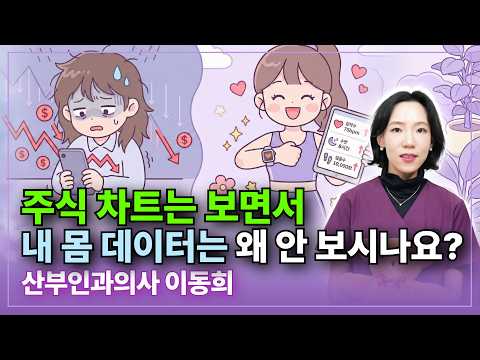
Today, my body feels heavy, but is it just my imagination? My face is flushed, could menopause be starting? In the clinic, we see many people who come with such vague concerns. We ride the waves of hormones throughout our lives, from menarche to pregnancy, childbirth, and menopause, but most of us rely on intuition to know when those waves will come and how high they will be. Signals arrive, but without interpretation, anxiety builds. In this article, I've compiled stories about Femtech, which transforms that vagueness into data, from the perspective of an OB/GYN.
What is Femtech and Why is it Gaining Attention Now?
Femtech is a portmanteau of 'Female' and 'Technology.' While in the past it might have just meant circling the start date of your period on a calendar, it has now evolved to handle women's health data much more precisely.
There's also an interesting point: many healthcare products developed so far have often been designed assuming users are generally young, healthy, and close to a standard body type. Yet, those who most desperately need technological assistance often fall outside these criteria.
Technology should move towards addressing the actual discomforts of women that have not been sufficiently dealt with until now.
Therefore, modern Femtech is expanding beyond just a recording tool to encompass the entire female life cycle.
- Ovulation tracking during infertility preparation
- Fetal movement and condition management during pregnancy
- Recording menstrual cycle and symptom patterns
- Menopausal hormone changes and menopause management
These records are particularly meaningful for menopausal women who struggle with sleep due to hormonal changes, women with polycystic ovary syndrome suffering from irregular periods, and those with chronic diseases.
A 24-hour Secretary that Fills the Gaps of a 5-minute Consultation
Hospital consultations typically last about 5 minutes, or at most 10 minutes. When I ask, 'How many times did you experience hot flashes last month?', many patients reply, 'I can't quite remember,' or 'I vaguely recall it was once a day.' It's not the patient's fault. It's natural to forget if you don't record it.
This is precisely where Femtech acts as a 24-hour secretary. It meticulously collects and presents body signals that you might have forgotten or overlooked due to busyness, turning them into data. You can show these records during your consultation or objectively check 'this is what my body was like' before coming to the hospital. A similar context is also summarized in Menopause Self-Diagnosis: Checking Hormones at Home.
Does it Really Work? Digital Tools Through Research
Will using an app really make a difference? Let's look at reported research. A paper published in a menopause-related journal in 2022 analyzed the impact of web or app-based interventions on menopause management by compiling studies from various countries. The following changes were reported in groups that consistently used digital tools:
| Category | Reported Change |
|---|---|
| Weight and waist circumference | Tendency to decrease compared to non-users |
| Knowledge about menopause | Increased |
| Depression | Noticeable tendency to decrease |
However, the degree of change may vary individually. Why did these results appear? It's not because the app directly causes weight loss or merely records data. As you record what you eat and under what circumstances your heat flashes worsen, patterns emerge. Connections like 'I can't sleep the night after eating spicy food, and the next day is harder' become apparent.
Consult on how to interpret my symptom recordsHow Data Changes Conversations with Doctors
In this study, what I found particularly important was how communication with doctors changes through apps. Instead of vague expressions like 'I just don't feel well,' you can provide specific details such as 'These symptoms appeared a few days before my period, and my weight increased by this much.' When you provide such specific information, it becomes easier for doctors to make more accurate judgments.
I see this as self-determination in managing one's own health data. When confidence arises, not just 'the doctor will take care of it,' but 'I am taking care of my own health data,' vague anxiety can quickly shift to concrete solutions. If you're curious about overall menopausal changes, I recommend also reading An Article Summarizing Menopausal Body Changes, Symptoms, and Causes.
Wearables if Manual Recording is Difficult
If manual recording every time is cumbersome, there are wearable devices. These are devices like smartwatches or smart rings that monitor your body even while you sleep. While in the past it might have been about checking 'Did I walk 10,000 steps today?', recent devices also measure sleep quality, subtle changes in basal body temperature, heart rate variability, and oxygen saturation. The significance lies in their ability to help estimate hormone rhythms based on these measurements.
- Basal body temperature Basal body temperature subtly rises during ovulation, and devices can detect this change to help estimate the flow of the menstrual cycle.
- Sleep efficiency and heart rate During menopause, the autonomic nervous system can become unstable, leading to a tendency for heart rate to rise during sleep or difficulty achieving deep sleep. If sleep efficiency is low, the device can proactively inform you, 'Today, your symptoms might be a little more concerning.'
When such data accumulates over a month or a year, a 'body weather forecast system' is created. Just as you see a 'bring an umbrella' notification in the morning news, the device might tell you, 'Your body score is low today, so avoid strenuous exercise.' The focus shifts from seeking medicine after illness to proactive preparation.
Which App to Choose? Three Criteria
Many people feel overwhelmed when they enter the app store, unsure of what to use. It's good to keep the following three points in mind when choosing:
- Does it treat me as the protagonist? Rather than just receiving input, an app that interacts with you based on your data, like 'You didn't sleep well yesterday, so try reducing caffeine today,' is good.
- Is the source of information clear? Information from unclear sources can actually be harmful. Check who participated in its development and what evidence it's based on. It should be a medically evidence-based app.
- Does it have a community feature? Going through menopause alone can be difficult. Just talking to others experiencing similar symptoms can provide psychological comfort and help improve depressive symptoms.
Data is Just a Tool, Interpretation is in Consultation
One thing I want to make clear: the numbers shown by wearables or apps are excellent clues, but they are not diagnoses themselves. A low body score does not immediately mean illness, nor does a high score mean you can skip all check-ups. Data is a tool, like a stethoscope, that helps you hear your body's signals more clearly, and the interpretation of those sounds and the determination of the next steps should be done together in the consultation room. The value of data increases when it is used alongside regular menopause screening.
Conclusion
Menopause is often called the beginning of life's second act. Rather than letting this period pass by saying, 'Oh, I guess everything changes with age,' I encourage you to calmly manage it with data and read your body's signals. It's enough if you can wake up in the morning and lightly envision your day, thinking, 'My condition is good today.' The first step to turning vagueness into certainty is closer than you think.
Consult if you're curious about managing your body dataWritten by: Lee Dong-hee CEO & Director · OB/GYN Specialist · View Medical Staff Profile
This article is based on content from a YouTube video · First published January 30, 2026 · Last reviewed May 30, 2026
This article provides general health information and does not replace individual diagnosis or treatment. If you have symptoms, please consult a doctor through a medical examination.