
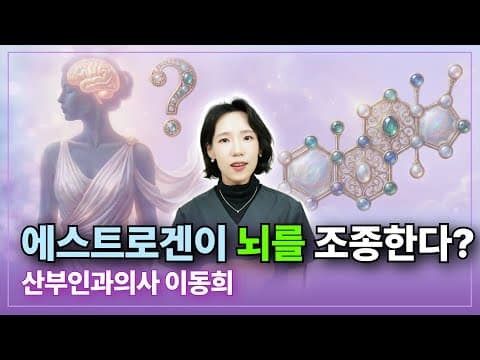
You might find yourself holding your phone one moment and then unable to recall where you put it, or words lingering on the tip of your tongue. With shallow sleep and increased sensitivity, a fear of 'Am I developing dementia?' might cross your mind. In the clinic, many women in their late 40s to 50s share these concerns. To put it simply, most of these symptoms are not dementia. Nor are they merely signs of aging or a lack of willpower. They could be a candid signal from your body saying, 'Fuel is low right now.' Today, we will discuss how the three concerns of memory, mood, and sleep are connected by the single thread of estrogen.
Brain Fog: A Feeling of Fog in the Head
A state where your mind feels hazy as if covered in fog, words don't come to mind immediately, and it's difficult to handle multiple tasks simultaneously is often called brain fog. Why does this symptom become prominent during the menopausal transition? The key is estrogen.
Many people only think of estrogen as a reproductive hormone, but from the brain's perspective, estrogen is more like a type of fuel. It supplies energy to brain cells, helps signal transmission between nerve cells, and protects circuits that store memories. Therefore, when estrogen levels decrease, the brain's operational efficiency can also be affected.
The feeling of words lingering on the tip of your tongue and your work speed not being what it used to be is less about a weakening will and more about the brain's fuel supply switch being temporarily turned down.
Indeed, brain imaging studies also report reduced brain glucose metabolism and temporary changes in hippocampal volume related to memory during the menopausal transition. However, individual differences can exist, so the severity of symptoms may vary from person to person even during the same period.
How Are Brain Fog and Dementia Different?
The most frequent question I receive in the clinic is, 'Will this really lead to dementia?' These two conditions are distinctly different. Let's summarize them in the table below.
| Category | Brain Fog | Dementia |
|---|---|---|
| When given hints | Memory returns | Often doesn't recall even with hints |
| Variability | Fluctuates with condition | Tends to gradually worsen over time |
| When concentrating | Can perform tasks with concentration | Daily life performance becomes increasingly difficult |
The key is that brain fog is a condition that can potentially be reversed with focus and management. Understanding this difference can significantly reduce vague fears. However, if symptoms rapidly worsen or significantly interfere with daily life, an evaluation through a medical consultation is necessary rather than self-diagnosis.
Sleep: Why Rhythm is More Important Than Quantity
If you ask, 'Does good sleep solve everything?' the answer is half yes and half no. When sleep is insufficient, the brain perceives it as an emergency, secreting more stress hormone, cortisol. The problem is that this cortisol burdens the hippocampus, which is responsible for memory, and creates a vicious cycle.
- Insufficient sleep increases cortisol.
- Increased cortisol interferes with the synthesis of serotonin, which regulates mood.
- Lack of serotonin also reduces the production of melatonin, which aids sleep.
- As a result, it becomes difficult to fall asleep again, and the same cycle repeats.
Therefore, menopausal insomnia is more accurately viewed not as a simple sleep habit issue, but as a problem where hormones and brain circuits are intertwined. If you are curious about the connection between sleep and menopause, you may also find An overview of menopausal insomnia and sleep helpful.
Mood Swings: It's Not Your Personality Changing
You might find yourself tearing up over things you'd normally laugh off, or getting irritated by trivial remarks from family. In such moments, many people blame themselves, thinking, 'Am I too sensitive, or has my personality worsened?' Estrogen acts as a kind of guard that protects neurotransmitters like serotonin and dopamine, which regulate mood. When this guard weakens, it's like the emotional buffer system is reduced.
In other words, it may not be a weakening of your mind, but a sensitive brain response due to hormonal changes. Simply understanding that your personality hasn't changed can reduce self-blame.
If you feel it's too difficult to bear alone, please feel free to ask. Consult symptoms online
Lifestyle Management You Can Try Starting Today
From the perspective of refilling the brain's fuel before medication, here are some things you can try in your daily life. As individual differences can exist, it is safer to confirm with a medical consultation if you have existing conditions or are taking medications.
- Phosphatidylserine: A component of brain cell membranes, relatively abundant in legumes.
- Lecithin and Choline: Precursors to memory neurotransmitters. Can be naturally supplemented through eggs.
- Magnesium: Used to calm the brain and help improve sleep quality.
In addition, the two easiest and most powerful things are morning sunlight and digital detox. Sufficient sunlight during the day is needed for serotonin to be well-produced, which then leads to melatonin at night. From an hour before bedtime, keep screens away to signal to your brain, 'It's night now.' For sleep, rhythm is more important than total quantity. If you are curious about the relationship between melatonin and brain health, The story of melatonin and brain health in menopausal women may also be helpful.
Don't Blame the Signals on Age
Memory decline, sleep problems, mood swings. These three may not be isolated malfunctions but branches that grew together from a single root: hormones. Therefore, I hope you don't dismiss these signals by thinking, 'It's just because I'm getting older.' Restoring hormonal rhythm is more than just reversing a single memory issue; it's closer to a process of regaining control over your life.
If you are curious about the bigger picture of menopausal changes, please refer to An article summarizing menopausal physical changes, symptoms, and causes. If you need consultation about hormonal changes themselves, please refer to Guidance on menopausal hormone management. If you wish to directly confirm where your symptoms originate, please inquire online comfortably.
Written by: Lee Dong-hee, Chief Director · Obstetrician and Gynecologist · View medical staff profile
This article is based on YouTube video content · First published January 8, 2026 · Last reviewed May 30, 2026
This article provides general health information and is not a substitute for individual diagnosis or treatment. If you have symptoms, please consult with a medical professional.