
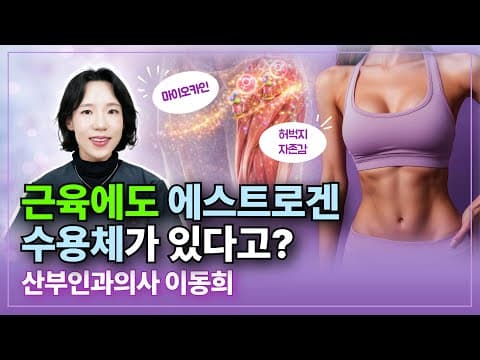
On the day of a menopause diagnosis, many people's first thought is osteoporosis. And they immediately look for calcium supplements. However, recent studies tell a slightly different story. The key to protecting bones may lie in muscles rather than calcium itself. To welcome the new year 2026, Dr. Lee Dong-hee, Chief Director of Uahan Women's Clinic, has explained in clinical terms the role of muscles in a body with reduced estrogen, and why strength training becomes the most reliable asset for menopausal women.
Estrogen Doesn't Only Come From the Ovaries
It is commonly thought that estrogen is produced only in the ovaries. In the clinic, we see surprisingly many people who misunderstand this point. While the ovaries are indeed the main factory, our bodies have another tissue that acts like an emergency generator: muscles.
The surface of muscle cells is densely populated with receptors that receive estrogen signals. What does this mean? It means that muscles are not merely organs that move the body; they also act as a kind of systemic regulatory device, directly receiving hormone signals and sending corresponding substances throughout the body.
If the ovaries are the main factory, muscles are the emergency generator that can take over some functions when that factory stops.
Therefore, even in situations where estrogen decreases after menopause, the body's response can vary depending on how muscles are managed.
Myokines: Signals Muscles Send to Bones
The key point introduced in this article is a study published in 2022. Its title is intriguing, directly posing the question: How does estrogen regulate muscle myokines to protect bones?
Myokines refer to signaling substances secreted by muscles when they contract and move. Until now, we have generally considered taking calcium as the primary action when osteoporosis occurs. However, this study explains that muscles can be active agents in regulating bones.
To summarize:
- When estrogen is sufficient: Muscles send signals that protect bones.
- When estrogen is insufficient: The system that produces myokines becomes unstable.
- When there is also a lack of exercise: Muscles may tend to activate cells that break down bone.
Cells that break down bone are called osteoclasts. This suggests that the muscles of menopausal women who rarely exercise might, while at rest, actually work to erode their own bones. While this may sound a bit alarming, it also implies that simply by using muscles effectively, there is potential to change this trend. If you are curious about the diagnosis and prevention of osteoporosis, we recommend reading the article Diagnosis and Prevention of Menopausal Osteoporosis.
Exercise: A Low-Impact Natural Hormone Management Method
The role of myokines is not limited to bones. When you exercise, myokines released from muscles travel throughout the body via the bloodstream.
- When it reaches the brain: It helps prevent a decline in cognitive function.
- When it reaches fat tissue: It is involved in burning fat, often referred to as "age-related fat."
- When it reaches blood vessels: It helps add elasticity to blood vessels.
At this point, one might want to call exercise a low-impact natural hormone management method. This is because it's not about taking separate medications, but rather signals that your own body produces. If you've wondered why weight gain is common after menopause, the article Menopausal Weight Gain and the Relationship with Hormones may also be helpful.
Many people also deliberate between exercise and medication. If hormone therapy supplements what is lacking, then exercise is closer to directly operating the factory within your own body. Greater synergy is reported when the two go hand in hand. If you wish to consult about a combination suitable for your condition through a medical examination, feel free to inquire below.
Consult about Menopausal Bone HealthWhy Two Hours of Walking May Not Be Enough
Sometimes patients tell me, "I walk for two hours a day." While walking is certainly a good activity, it may not be sufficient to elicit the myokines that protect bones.
The key is to apply a certain amount of load to the muscles. Muscles need to feel slightly sore and challenged for them to recognize the need to produce bone-protecting substances. Heavy dumbbells are not strictly necessary; tools found at home or just your body weight can be sufficient.
| Exercise | Targeted Area | Modified to Reduce Burden |
|---|---|---|
| Squats | Large thigh muscles | Half squats, holding position in a chair |
| Calf Raises | Calves, ankles | Slowly, holding onto a wall or chair |
| Push-ups | Upper body and core | Wall push-ups, on knees |
The thighs contain some of the largest muscles in our body, so squats are particularly beneficial. Calf raises, slowly lifting your heels, and push-ups, which engage the entire body, are also good. If the movements are too challenging, you can start by placing your hands on a wall or your knees on the floor. These can be done sufficiently with just your body weight, so please don't think of them as too difficult.
If You Have Joint Pain or Are Taking Medication
For those who already have knee joint issues, strenuous squats can actually be a burden. In such cases, it is safer to start with exercises like holding a straight leg position, half squats, or isometric exercises where you hold a seated position in a chair. It is advisable to gradually increase the range of motion after the muscles around the knee have first strengthened.
Protein is also a frequently asked question. After menopause, protein absorption tends to decrease, so if diet alone is not sufficient, supplements can be an option. It is important to adjust the appropriate amount considering body weight and activity level, and if you have underlying conditions such as kidney disease, be sure to decide after consulting with a doctor. If you are curious about overall physical changes during menopause, you may also refer to the article Menopausal Body Changes, Symptoms, and Causes.
Cherish Your Leg Muscles Starting Today
The decrease in hormones is an unstoppable natural process. However, there's no need to let this change also diminish your quality of life. Menopause is not an end, but rather a turning point for changing how you manage your body.
Starting today, please cherish your thigh and leg muscles a little more. The muscles you build now will become a strong support, protecting your gait and self-esteem ten years from now. If you are concerned about symptoms or the timing of tests, please feel free to inquire through Consult about Menopausal Bone Health and Exercise through Medical Consultation. We support your elegant tomorrow.
Written by: Lee Dong-hee Chief Director · Obstetrician and Gynecologist · View Medical Staff Profile
This article is based on the content of a YouTube video · First published January 14, 2026 · Last reviewed May 30, 2026
This article provides general health information and is not a substitute for individual diagnosis or treatment. If you have symptoms, please consult through a medical examination.