
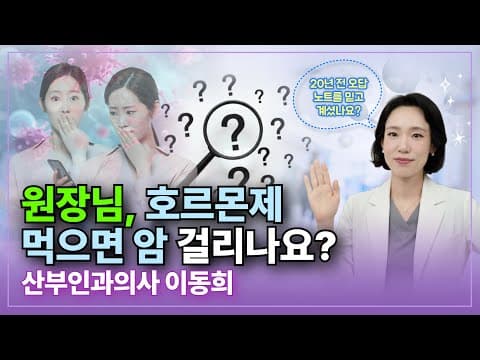
When I bring up hormone therapy in the consultation room, eight out of ten patients ask similar questions. "Doctor, I heard it causes cancer?" "Don't I have to take it for life once I start?" Honestly, my heart feels a little heavy when I hear such remarks. This is because many people suffer from menopausal discomforts, yet spend sleepless nights and feel drained due to vague anxiety. Today, let's calmly examine what constitutes a real risk and what is an outdated misunderstanding regarding hormone therapy during the menopausal transition.
Where Did the Fear Begin?
A significant portion of the fear surrounding hormone therapy originated from a large-scale study published in 2002. For a while after this study came out, hormone prescriptions almost ceased. However, if you look closely at the study, a crucial premise is missing.
A significant number of the study participants at the time were women over 60, who had been post-menopausal for more than 10 years, and many also had accompanying conditions like high blood pressure, diabetes, and vascular disease.
Their starting point was fundamentally different from women in their 50s who are just going through menopause. Furthermore, the hormones we use today have much lower doses than back then, and the forms have diversified beyond oral pills to include transdermal patches, gels, and even vaginal inserts. Prescription criteria have also become more sophisticated. Therefore, I see that study not as today's correct answer, but rather as an incorrect answer sheet that showed us what we needed to improve.
The Most Important Concept: Window of Opportunity
This brings us to a core concept: the window of opportunity, often called the golden time. The outcome can be quite different depending on when treatment begins.
When started just before menopause, or within 10 years after menopause, and before the age of 60, better results are reported not only for symptom relief like hot flashes and night sweats but also for osteoporosis prevention and cardiovascular health. That's why nowadays, hormone therapy is viewed not as "medicine taken for pain," but as a choice to prepare for a healthy future. If you want to understand why physical changes occur during menopause, I recommend reading this article explaining the causes and mechanisms of menopausal body changes and symptoms together.
But Why Do They Keep Saying It's Dangerous?
Despite this, why do discussions about cancer, blood clots, and heart disease continue to be associated with it? The answer is simple: it's not a treatment that applies equally to everyone.
- Whether there is a family history of breast cancer
- What the breast density is
- Whether there are risk factors for blood clots
- Whether one smokes, and what their lifestyle habits are
The balance of risks and benefits changes depending on these conditions. Therefore, the direction of hormone therapy today has shifted from "good for everyone / bad for everyone" to considering "which is more beneficial for this individual."
Look at Numbers, Not Emotions
The reason why talk of danger sounds particularly loud might be because we've never calmly considered it with numbers. So today, let's compare with numbers instead of emotions. While there are differences between studies, the approximate scale can be summarized as follows:
| Situation | Relative Magnitude of Additional Breast Cancer Risk |
|---|---|
| 1,000 people on hormone therapy for 5 years | Baseline level |
| Daily habitual glass of alcohol | Slightly higher level than hormone therapy |
| Obesity after menopause | Several times the level of hormone therapy |
In the consultation room, hardly anyone loses sleep over a daily glass of wine, thinking, "I might get breast cancer from this." Yet, when the term hormone therapy comes up, people become much more anxious about a similar magnitude of risk. In reality, there might be other areas that require more attention.
After menopause, with hormonal changes, activity levels tend to decrease, sleep can be disrupted, and weight management can easily falter. Uncomfortable symptoms combined with feelings of depression can lead to overeating, creating a vicious cycle where weight gain, in turn, increases other risks. If you are curious about this progression, this article explaining why weight gain is more common during menopause from a hormonal perspective may be helpful.
Consult to find out what choice is best for my situationSo, the conclusion I want to emphasize most is this: it's not about "avoiding cancer at all costs," but about discussing together "how to wisely utilize it for the overall benefit of my body."
When I prescribe hormone therapy, I never make the decision alone. I put all factors on the table: the patient's family history, their most challenging symptoms, points of anxiety, lifestyle habits, and patterns, and we review them together one by one. This process of deciding together is called shared decision-making. If the benefits clearly outweigh the risks, there's no reason not to choose it. Ultimately, what matters most is your quality of life.
Actual consultations proceed in this order:
- I first ask what the most uncomfortable symptoms are.
- I assess whether systemic hormone therapy is needed, or if local hormone therapy alone is sufficient.
- We start with the lowest dose, in a comfortable method, whether oral or patch.
- Through regular check-ups at 3, 6, and 12 months, we reconfirm if it is still necessary.
Check-ups are more important than starting hormone therapy. This is because as the body's condition changes over time, the dosage or method may need to be adjusted accordingly. If you want to know more about who needs hormone therapy and in what cases, you can refer to Q&A on when hormone therapy is needed and Q&A on the risks and safety of hormone therapy. If you are concerned about bone health, which should also be managed during menopause, this article on the diagnosis and prevention of menopausal osteoporosis is also recommended.
Don't Just Let This Period Pass By
The menopausal transition is not a time of losing femininity. Rather, it is a time to put your own body back at the center, a body that may have been forgotten while focusing on family and work. I hope you don't let this precious period slip away simply due to fear.
Hormone therapy is not something to be feared, but one of several available options. However, whether it is right for you can vary depending on your individual health status, so rather than deciding alone, be sure to discuss it with a specialist. If you watch the video and wonder "which side am I on?", feel free to consult. If you want to review your symptoms and situation together, please request a consultation.
Written by: Lee Dong-hee, Chief Director · Obstetrician and Gynecologist · View Medical Team Profile
This article is based on the content of a YouTube video · First published January 7, 2026 · Last reviewed May 30, 2026
This article provides general health information and is not a substitute for individual diagnosis or treatment. If you have symptoms, please consult through a medical examination.